
Blogs
Revolutionizing Manufacturing with Salesforce: The Future of Smart Factories
Overview
The manufacturing industry is evolving rapidly, with companies seeking smarter, more connected, and efficient solutions to meet the demands of Industry 4.0. Salesforce, a global leader in cloud-based CRM, has introduced powerful solutions tailored for manufacturers, helping them streamline operations, enhance customer relationships, and drive business growth.
Table of Contents
- The Role of Salesforce in Manufacturing
- Key Features and Benefits of Salesforce for Manufacturing
- Result of Implementing Salesforce Manufacturing Cloud
- The Future of Manufacturing with Salesforce
- Conclusion
The Role of Salesforce in Manufacturing
Manufacturers today face complex supply chains, fluctuating customer demands, and increasing competition. Salesforce provides an integrated platform that connects data, processes, and people, enabling manufacturers to make real-time decisions, automate workflows, and improve customer engagement.
1. Salesforce Manufacturing Cloud: A Game-Changer
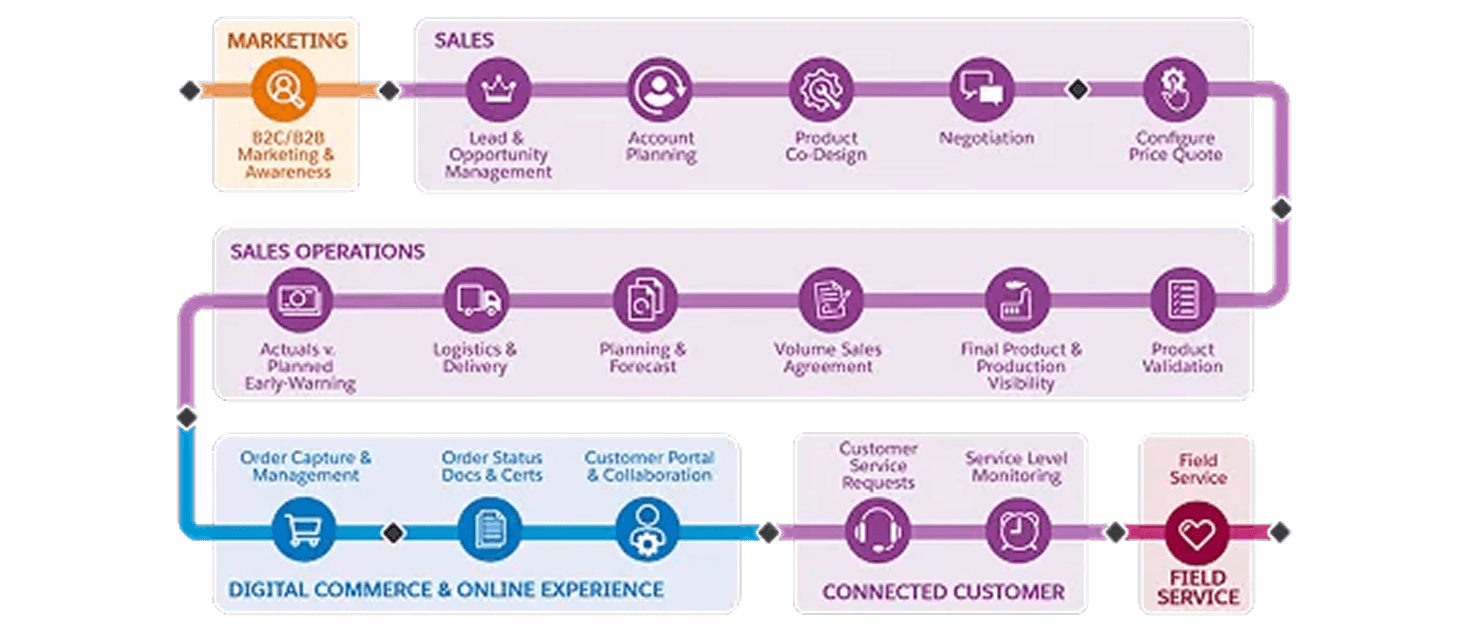
Manufacturing Cloud, a purpose-built solution for the industry, offers a centralized platform that integrates sales, operations, and customer service. Key benefits include:
- Sales Agreements & Forecasting: Accurately predict demand by tracking sales agreements and historical data.
- Sales Agreements & Forecasting: Enable better communication between sales, service, and operations teams.
- Performance Insights: Use AI-driven analytics to make data-backed business decisions.
2. AI and Automation with Salesforce Einstein
Artificial Intelligence (AI) is transforming manufacturing by enabling predictive maintenance, automated workflows, and intelligent analytics. Salesforce Einstein AI enhances manufacturing operations by:
- Detecting production inefficiencies and predicting failures before they occur.
- Automating routine tasks, allowing employees to focus on high-value activities.
- Providing AI-driven insights to personalize customer interactions and improve engagement.
3. Connected Supply Chains with IoT Integration
The Internet of Things (IoT) has revolutionized manufacturing by connecting machines, products, and systems to provide real-time data. Salesforce's IoT Cloud enables:
- Predictive Maintenance: IoT sensors detect potential machine failures, reducing downtime.
- Smart Inventory Management: Real-time tracking of materials to optimize production.
- Automated Alerts: Instant notifications when there are disruptions in the supply chain.
4. Enhancing Customer Experience with Service Cloud and Customer 360
In today's competitive market, manufacturers must prioritize customer experience. Salesforce Service Cloud and Customer 360 offer:
- AI-Powered Chatbots: Automate customer support for quick issue resolution.
- Field Service Management: Optimize scheduling, dispatching, and tracking of field technicians.
- 360-Degree Customer View: Consolidate customer interactions across multiple channels, providing a complete picture of each customer.
- Personalized Engagement: Leverage data from multiple touchpoints to deliver customized experiences and proactive service.
5. Integration with Smart Manufacturing Systems
Salesforce seamlessly integrates with leading ERP (Enterprise Resource Planning) and MES (Manufacturing Execution Systems), enabling manufacturers to:
- Synchronize production planning with real-time demand forecasting.
- Enhance shop floor visibility with real-time dashboards.
- Improve compliance tracking and quality assurance.
6. Agentforce in Manufacturing
Salesforce is continuously innovating to provide cutting-edge solutions for manufacturers. A recent addition to its suite of AI-powered tools is Agentforce, which enhances automation in customer service and operations. Key trends include:
- AI-Driven Virtual Agents: Automate customer support for quick issue resolution.
- Predictive Analytics for Sales and Inventory: Leveraging machine learning to forecast demand and optimize stock levels.
- Hyper-Personalization: Using AI to deliver tailored recommendations and proactive service.
- Advanced Workflow Automation: Streamlining manufacturing operations by reducing manual interventions.
Key Features
- Sales Forecasting and Agreements: Manufacturing Cloud enables accurate demand forecasting by managing complex sales agreements and large orders. This visibility allows for better production planning and inventory management.
- Account-Based Marketing: The platform facilitates targeted marketing campaigns by providing insights into customer behaviour, enabling personalized engagement strategies.
- Configure, Price, Quote (CPQ): Salesforce streamlines the quoting process with guided selling and configurable products, ensuring accurate proposals and faster deal closures.
- Field Service Management: The integration of Salesforce Field Service optimizes technician scheduling, dispatching, and asset tracking, leading to improved operational efficiency and customer satisfaction.
- Field Service Management: The integration of Salesforce Field Service optimizes technician scheduling, dispatching, and asset tracking, leading to improved operational efficiency and customer satisfaction.
Benefits
- Increased Operational Efficiency: Streamline processes and reduce downtime.
- Enhanced Customer Engagement: Deliver personalized experiences with Customer 360.
- Improved Demand Forecasting: Use AI-driven insights for accurate sales and inventory planning.
- Cost Reduction: Minimize waste and optimize resource utilization.
- Scalability: Easily adapt to changing business needs and expand operations.
The Future of Manufacturing with Salesforce
As manufacturing continues to evolve, Salesforce is leading the way with innovations in AI, automation, and data analytics. By leveraging Manufacturing Cloud, IoT, and AI-driven insights, manufacturers can future-proof their operations and stay ahead in the digital era.
Conclusion
Salesforce is more than just a CRM; it is a strategic partner for manufacturers looking to embrace digital transformation. By implementing Salesforce solutions, manufacturers can enhance efficiency, improve customer relationships, and drive sustainable growth in an increasingly connected world.