Blogs
Sustainable Quality Engineering (SQE)
Overview:
For years, software quality was measured by how many defects were found before release. Later, success was defined by how much automation was achieved. Today, neither metric alone is sufficient.
Modern digital products are always evolving, released continuously, and expected to perform flawlessly across platforms and geographies. In this environment, quality must be designed to last, not patched at the end.
This is where Sustainable Quality Engineering (SQE) comes in.
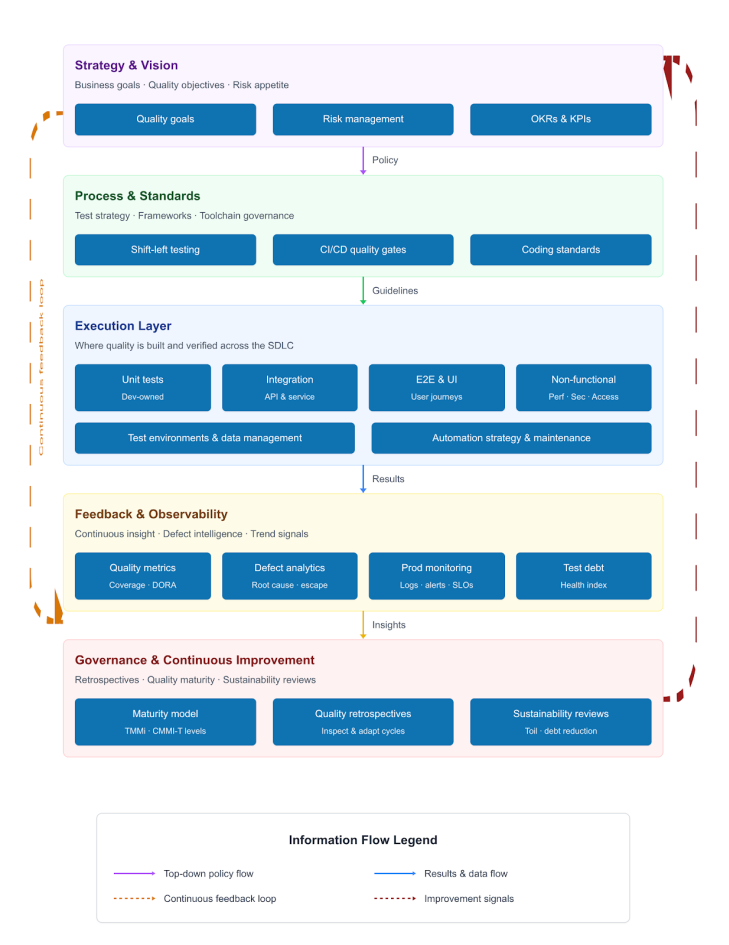
SQE is not a tool, framework, or process. It is a mindset and operating model that ensures quality practices remain effective, scalable, and resilient over time.
What Is Sustainable Quality Engineering?
Sustainable Quality Engineering is the practice of embedding quality into every stage of the software lifecycle in a way that:
- Scales with business growth
- Adapts to change
- Minimizes long-term cost and effort
- Reduces human dependency
- Improves continuously through feedback
Sustainability in quality means you are not constantly "fixing the process" just to keep up.
Why Traditional QA Models Are Not Sustainable
Common Symptoms
- Automation suites that break every sprint
- Heavy manual regression cycles
- Quality dependent on a few key individuals
- Late defect discovery
- Rising maintenance costs
Root Cause
Traditional QA often focuses on short-term coverage, not long-term viability.
Example
A team achieves 80% automation coverage in one year—but spends year two fixing broken scripts instead of adding value.
This is not sustainable.
Limitations of UI Automation
Common Symptoms
- Automation suites that break every sprint
- Heavy manual regression cycles
- Quality dependent on a few key individuals
- Late defect discovery
- Rising maintenance costs
Root Cause
Traditional QA often focuses on short-term coverage, not long-term viability.
Example
A team achieves 80% automation coverage in one year—but spends year two fixing broken scripts instead of adding value.
This is not sustainable.
Core Principles of Sustainable Quality Engineering
1. Shift Quality Left and Right
Quality must start early and continue after release.
Shift-Left Examples
- Testability reviews during design
- Acceptance criteria written as test scenarios
- API contracts validated before UI exists
Shift-Right Examples
- Production monitoring
- Synthetic transactions
- User behaviour feedback loops
Sustainable teams prevent defects early and learn from production continuously.
2. Risk-Based Testing Over Blanket Coverage
Testing everything equally is expensive and ineffective.
Sustainable approach:
Focus effort where business impact and technical risk intersect.
Example
- Payment flow → deep functional, security, and performance testing
- Static UI content → minimal automated coverage
This ensures testing effort delivers maximum value per test.
3. Automation That Is Maintainable, Not Just Automated
Automation is only sustainable when:
- It is modular
- It is readable
- It is resilient to change
Unsustainable Automation
Focus effort where business impact and technical risk intersect.
- Hard-coded locators
- Long end-to-end scripts
- No ownership or review
Sustainable Automation
- Page Object / Screenplay patterns
- API-first testing
- Parallel execution
- Self-healing where appropriate
Example
Moving 70% of regression from UI to API reduced execution time by 60% and maintenance effort by 40%.
4. AI as an Enabler, Not a Crutch
AI strengthens sustainability when used responsibly.
Sustainable AI Use Cases
- AI-generated test scenarios from requirements
- Self-healing locators
- Intelligent test prioritization
- Defect clustering and prediction
Unsustainable AI Use
- Blind trust in AI-generated tests
- No human validation
- No governance or feedback loop
AI should reduce effort—not eliminate accountability.
5. Built-In Quality Ownership
Sustainability requires shared responsibility.
| Role | Quality Responsibility |
|---|---|
| Product Owner | Clear acceptance criteria |
| Developer | Unit & integration quality |
| Tester | Risk analysis & validation |
| DevOps | Quality gates & monitoring |
Quality owned by everyone is quality that lasts.
Sustainable Quality Engineering in Action (Examples)
Example 1: API-First Testing Strategy
Problem:
UI automation was fragile and slow.
| Solution | Outcome |
|---|---|
| Shifted core business validations to API tests | Faster feedback |
| Used UI tests only for critical journeys | Lower maintenance |
Example 2: Self-Healing Automation
Problem:
UI changes caused frequent automation failures.
| Solution | Outcome |
|---|---|
| Introduced self-healing locators | 50% reduction in false failures |
| Added AI-assisted failure analysis | Testers focused on analysis, not script fixes |
Example 3: Production Feedback Loop
Problem:
Defects were discovered only after release.
| Solution | Outcome |
|---|---|
| Monitored production errors | Fewer escaped defects |
| Mapped incidents back to missing test coverage | Continuous test suite improvement |
Metrics That Support Sustainability
| Metric | Why It Matters |
|---|---|
| Defect leakage | Measures residual risk |
| Automation stability | Measures sustainability |
| Mean time to detect defects | Measures feedback speed |
| Test maintenance effort | Measures long-term cost |
| Release predictability | Measures trust |
Skills for Sustainable Quality Engineers
The role of a tester evolves from executor to quality strategist.
Key Skills
- Risk analysis
- Automation architecture
- Data interpretation
- AI validation
- Business domain understanding
Sustainable quality comes from thinking, not just testing.
The Role of a QA CoE in Sustainability
A mature QA CoE enables sustainability by:
Key Skills
- Defining standards
- Rationalizing tools
- Governing AI usage
- Driving continuous improvement
- Measuring long-term effectiveness
Without a CoE, sustainability remains accidental.
Final Thoughts
Sustainable Quality Engineering is not about:
Key Skills
- More test cases
- More tools
- More automation
It is about making quality easier to maintain tomorrow than it is today.
If your quality process collapses when people change, tools change, or requirements change—it is not sustainable.
Organizations that invest in sustainable quality build software that is:
- Resilient
- Adaptable
- Trustworthy
And ultimately, successful.
Content Quick Links
- Overview
- What Is Sustainable Quality Engineering?
- Why Traditional QA Models Are Not Sustainable
- Limitations of UI Automation
- Core Principles of Sustainable Quality Engineering
- Sustainable Quality Engineering in Action (Examples)
- Metrics That Support Sustainability
- Skills for Sustainable Quality Engineers
- The Role of a QA CoE in Sustainability
- Final Thoughts